Last updated October 31, 2026
 Smart locks
 House lockouts
 Re-keying
 Deadbolt upgrades
 Schlage
 Kwikset
 Car keys & fobs
Non-destructive entry first, always - and we re-key Schlage, Kwikset, and Baldwin locks on the spot while you watch
You get a price before we start. It does not change when we arrive. No surprises.
Get your free estimateLocksmith Warning Signs: A Grand Rapids Homeowner’s Reference Guide
Here’s a counterintuitive truth from years of working on Grand Rapids locks: the lock that fails suddenly on a January night at 11:30 PM almost always started announcing its failure weeks earlier. The warning signs were there. A key that needed a wiggle. A deadbolt that required a lift on the handle. A latch that dragged. Most homeowners in Grand Rapids interpret these as quirks of an older home, things you just live with. They’re not quirks. They’re mechanical distress signals with a predictable timeline, and learning to read them is the difference between a planned $45 rekey and a frozen-lockout at the worst possible moment. This guide walks through every common warning sign, explains what each one actually means inside the lock, and gives you a realistic window for action before the lock makes the decision for you.
Quick Answer
Signs you need a locksmith in Grand Rapids include: a key that sticks or resists turning, a deadbolt that needs the door lifted or pulled to engage, a latch that retracts slowly or not at all, a cylinder that rotates loosely or spins, visible wear inside the keyway, and electronic locks showing inconsistent response or error codes. Most of these are repairable for far less than replacement cost if addressed within a week or two of first noticing them. Ignoring them converts a $40 to $120 service call into a $200 to $400 emergency.
Styles & brands we work with
Table of Contents
- Key Resistance: What Your Key Is Trying to Tell You
- Deadbolt Alignment: The Door Frame Problem That Strands You Outside
- Slow Latch Retraction and the Wear It Reveals
- Loose Cylinder Rotation: A Small Motion With Big Consequences
- Visible Keyway Wear and the Limits of a Cut Key
- Electronic and Smart Lock Warning Signs in Grand Rapids Homes
- How to Tell a Lock Problem From a Door Problem
- The Time-to-Act Reference Table: What Can Wait and What Cannot
Key Resistance: What Your Key Is Trying to Tell You
Key resistance is the most common early warning we hear about, and it’s also the most frequently dismissed. A key that needs a slight jiggle, a pull-back of an eighth of an inch, or a little extra torque is not “just how the lock is.” A properly functioning pin-tumbler lock, whether it’s a Kwikset, Schlage, or something more specialized like a Medeco, accepts its key smoothly and turns with consistent, light pressure. When that changes, something inside the cylinder has shifted.
Here’s what different types of key resistance specifically indicate:
- Resistance on insertion: Often means a pin or spring inside the cylinder has worn or broken, creating a physical obstruction in the keyway. It can also indicate debris accumulation, which is common in Grand Rapids homes near the lakeshore where fine sand works its way into daily life, or in older neighborhoods with heavy tree pollen each spring.
- Resistance when turning: This is the more serious signal. Pin-tumbler locks rely on pins that travel up and down in precisely machined chambers. When those chambers wear, pins hang up and the key fights them. Continued use accelerates the wear until the key eventually stops turning entirely.
- Resistance only in cold weather: Grand Rapids winters routinely push temperatures below freezing, and that matters for lock internals. Lubricant that has aged thickens in the cold. Moisture inside the lock freezes. If your key turns fine in August but fights you in February, the lock likely has internal moisture or degraded lubricant that needs professional cleaning.
- Resistance accompanied by a grinding sensation: This typically means a broken spring or a pin that has seized. Continuing to force the key risks snapping it inside the cylinder, which converts a simple service call into a broken-key extraction.
What should you actually do? First, avoid the instinct to spray WD-40 into the keyway. It’s a solvent that temporarily frees things up, then evaporates and leaves a residue that attracts dust and accelerates wear. Graphite is also over-recommended and can gum up modern locks that already have factory lubrication. If the resistance is new, or if it’s been building, the lock needs to be opened, cleaned, and inspected by someone who understands the mechanism. In many cases the fix is a cleaning and re-lubrication. In others, a single worn pin needs replacement. Waiting until the key stops turning entirely means paying for an emergency call, not a scheduled visit.
Deadbolt Alignment: The Door Frame Problem That Strands You Outside
If you have to lift the door handle, push on the door, or lean a shoulder into it to get the deadbolt to throw, you are not dealing with a lock problem at all. You’re dealing with a door frame alignment problem, and it’s one of the most common root causes of Grand Rapids lockout calls. It also happens to be the warning sign most often ignored for years at a time.
Here’s the mechanical reality: a deadbolt is a solid steel bar, usually one inch in throw, that slides into a precisely routed hole in the door frame. The lock’s internal mechanism moves that bar. When the door and frame are aligned, the bar travels straight into its strike with no friction. When the frame sags, or the door settles, or the hinges loosen, the bar begins striking the edge of the strike plate. That contact is what you feel as resistance when you lock the door.
Why do Grand Rapids doors sag? Several reasons, often working together:
- Seasonal humidity cycles. West Michigan swings from humid summers to dry winters. Wood doors and frames expand and contract. A door that fits perfectly in July may bind in January. Frame settlement is progressive: each cycle shifts the frame slightly.
- Foundation settling. Older Grand Rapids neighborhoods including Heritage Hill, Eastown, and the West Side have homes that are 80 to 120 years old. Foundation movement over decades gradually shifts door frames out of square. It’s not dramatic; it’s slow and cumulative.
- Hinge wear. Loose or worn hinge screws allow the door’s weight to pull it downward on the latch side. This is the most easily fixed cause and the one most often left unrepaired.
The security concern here goes beyond getting locked out. A deadbolt that only partially engages is a deadbolt that isn’t doing its job. When the bolt doesn’t fully seat in the strike, it can often be defeated with a pry bar or even a firm shoulder. That’s not a lock failure; it’s an installation failure. But the effect on your home’s security is identical.
The fix is usually straightforward: resetting the strike plate, tightening and possibly replacing hinge screws with longer versions that reach the stud, or in some cases re-mortising a shifted strike. This is routine work for any locksmith who understands door mechanics, not just lock internals. It rarely requires replacing the lock itself, which is why a knowledgeable technician will tell you that before recommending new hardware. The time to act is the first time you notice the lift-and-turn habit. That habit is the warning.
Slow Latch Retraction and the Wear It Reveals
A door latch that retracts slowly when you turn the handle, or that only partially retracts, is sending a different signal than key resistance. The latch mechanism operates independently of the key cylinder. It’s driven by the handle or knob through a spindle that rotates a cam inside the latch body. When that retraction feels sluggish, sticky, or incomplete, the problem is either in the latch assembly itself or in the connection between the handle and the latch.
Here’s what slow or incomplete latch retraction typically indicates:
- Worn internal spring: Latches use a spring to return the bolt to its extended position. When that spring weakens or breaks, retraction feels mushy and the latch may not fully extend after you release the handle. A latch that doesn’t fully extend is a latch that isn’t fully securing the door.
- Misaligned spindle: The spindle is the square bar connecting the handle to the latch mechanism. If it’s worn at the corners, it slips inside the latch hub and turns without fully retracting the bolt. You’ll feel the handle turn, but the latch barely moves.
- Debris in the latch body: Latch mechanisms sit inside the door edge, a natural collection point for dust, paint overspray, and humidity-driven corrosion. In Grand Rapids homes, decades of paint jobs often leave layers of paint on the door edge and latch face, and if that paint migrated into the mechanism, it impedes movement.
- Loose handle retention screws: Handles and knobs that wobble slightly are usually held by set screws that have backed off. That wobble changes the angle at which the spindle engages the latch, creating the sluggish feel.
The practical risk of a slow latch is different from a deadbolt problem. You’re less likely to be locked out and more likely to have a door that doesn’t fully close or latch behind you. That’s a security issue for obvious reasons: a door that doesn’t latch can be pushed open. It’s also an energy issue in a Grand Rapids winter, since an unlatched door doesn’t seal against its weatherstripping.
The good news is that latch problems are among the most affordable lock repairs. A new latch assembly, even for a higher-end lock from Baldwin or Yale, costs a fraction of what a full lock replacement runs. The labor to remove the old latch, clean the door edge, and install a fresh assembly is straightforward. The key is addressing the sluggish feel before the spring fully fails, because a fully failed latch means the door won’t stay closed at all, and that problem never announces itself at a convenient time.
Loose Cylinder Rotation: A Small Motion With Big Consequences
Grab the face of your lock, the round part where the key goes in. Try to rotate it with your fingers without a key inserted. On most locks, the cylinder should feel rock solid. On some designs, there’s a decorative collar that turns freely by design. But the cylinder itself, the core that holds the pins, should not rotate independently of the lock body. If it does, you have a specific and serious warning sign.
A rotating cylinder means one of two things. Either the retaining hardware that secures the cylinder to the lock body has failed, or the cylinder was never properly installed to begin with. Both scenarios create the same risks. And both are more common than you’d expect, particularly on older locks that have been in service for 15 or 20 years in Grand Rapids homes.
Here’s the anatomy. In most cylindrical locks, the cylinder is held in place by a retaining pin or clip accessible only from inside the lock body. In mortise locks, which are common in older Grand Rapids homes and are the format used by high-security brands like Mul-T-Lock and Medeco, the cylinder threads into the lock body and is secured by a set screw. When that retaining mechanism fails:
- The cylinder can rotate far enough to bind against the tailpiece, which is the part that actually retracts the bolt. You’ll feel it as a key that turns but doesn’t operate the lock.
- The cylinder can be pulled partially out of the lock, exposing the pins and rendering the lock inoperable.
- In the worst case, the entire cylinder unscrews or falls out, leaving you with a hole in your door where the lock used to be and no way to secure the home.
There’s also a security dimension beyond mechanical failure. A loose or partially extracted cylinder is dramatically easier to defeat than a properly seated one. Attack methods that exploit cylinder extraction rely on the cylinder already being loose or weakly retained. A properly installed cylinder on a quality lock resists these methods. A loose one invites them.
The fix is not a DIY project. Re-securing a cylinder requires opening the lock body, which means removing the lock from the door, or at minimum removing the interior escutcheon to access the retaining hardware. It’s a 20-minute job for someone who does this work regularly, and the cost is modest. But it’s also a job that goes wrong quickly if you don’t understand how the specific lock model is assembled. Baldwin locks retain cylinders differently than Kwikset locks, and high-security cylinders from Medeco and Mul-T-Lock have their own retention systems that require specific training to service.
Visible Keyway Wear and the Limits of a Cut Key
Look closely at the keyway of your most-used lock, the slot where the key enters. On a new lock, that slot has crisp, machined edges. On a lock that has seen ten years of daily use, you’ll often see something different: rounded edges, a widened slot, faint horizontal scratches, or even a slight funnel shape. That’s material that has physically worn away, and it’s writing a clear message about the lock’s remaining service life.
Keyway wear matters because the keyway is more than just an opening. It positions the key at the exact depth and angle required for the pins to interact correctly. When the keyway widens, the key sits slightly lower or slightly angled within the lock. The pin heights that once matched the key cuts now interact at the wrong depth, causing intermittent operation. You’ll notice it as a lock that works most of the time but occasionally refuses to turn, or requires the key to be pulled out, rotated, and reinserted.
There’s also a compounding failure mode. A worn keyway accelerates wear on the key itself. The key begins to rock slightly in the slot, which means the edges of the key cuts grind against the pins at suboptimal angles. Before long, the key itself is worn enough that it needs to be cut from the original code rather than copied from the worn key. If you’ve ever had a duplicate key made from a worn original and found that it didn’t work, you’ve experienced this cycle.
In our experience working on Grand Rapids locks, keyway wear is most pronounced on doors that get used multiple times a day: front doors, back doors off the kitchen, and any door that leads to a garage. It’s also accelerated by environmental factors. Grit, road salt residue from winter boots, and general atmospheric moisture all contribute to the slow abrasion of the keyway surfaces.
The takeaway: keyway wear is not repairable. You can’t put material back. When the keyway has visibly widened or rounded, the cylinder is reaching the end of its useful life and replacement is the honest recommendation. The good news is that cylinder replacement is straightforward on most locks, and it’s a fraction of the cost of replacing the entire lockset. If the lock is from a brand we service regularly, including Schlage, Kwikset, Yale, or Baldwin, a new cylinder restores the lock to like-new function without disturbing the existing hardware and finish.
Electronic and Smart Lock Warning Signs in Grand Rapids Homes
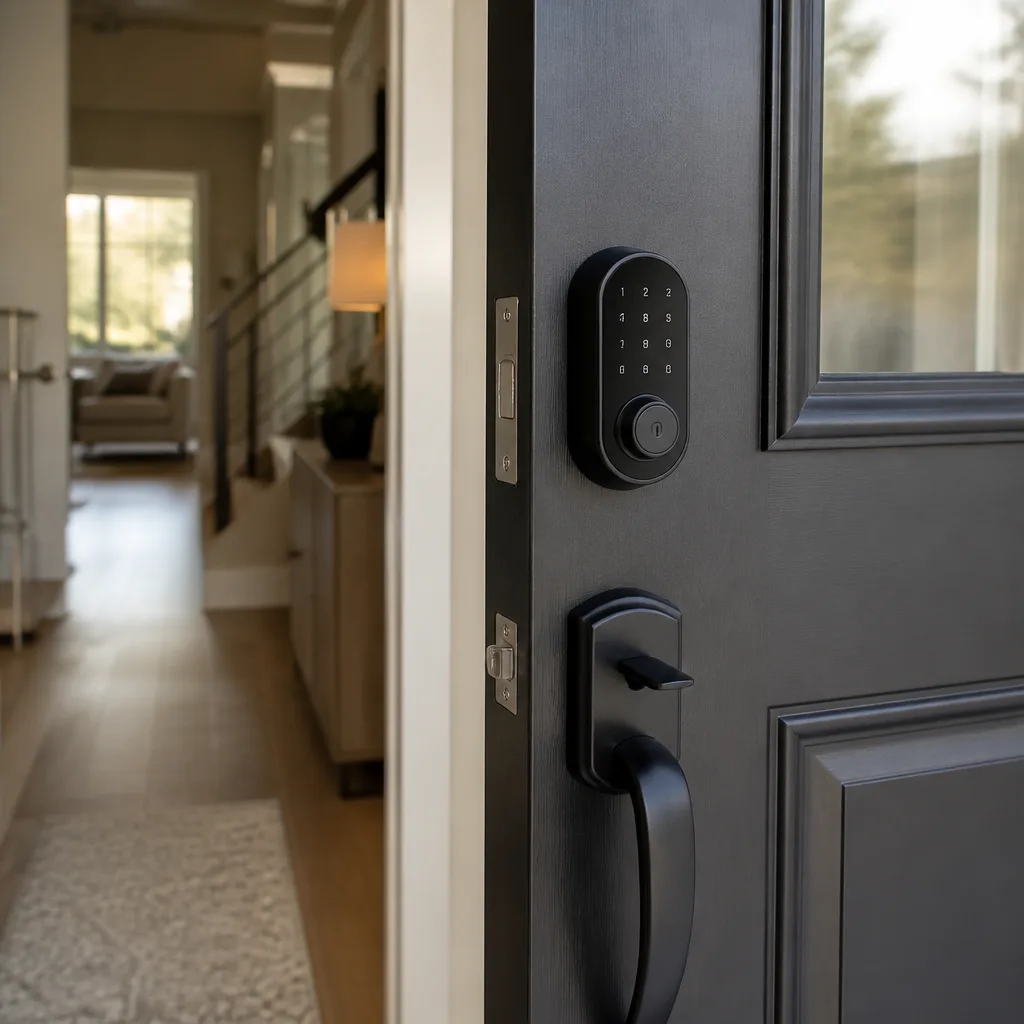
Electronic locks have become common on Grand Rapids homes, from simple keypad deadbolts on rental properties to full smart lock systems with app integration. They bring a different failure profile than mechanical locks, and the warning signs are different too. The good news is that electronic locks almost always warn you before they fail completely. The bad news is that most homeowners interpret those warnings as technology quirks rather than pre-failure indicators.
Error Codes and Inconsistent Response
Every electronic lock has a diagnostic language. Repeated error codes, lights that flash in unexpected patterns, or a lock that sometimes responds instantly and sometimes delays by several seconds are all early warning signs. A one-time error after a battery change is normal. The same error appearing weekly is not.
Delayed response is particularly diagnostic. It often means the lock’s internal motor is straining, which means battery voltage is dropping below optimal, which means the lock is consuming more power than it should, which typically traces back to a misaligned bolt fighting the strike plate. The lock is working harder than it should on every cycle, and that strain shows up as lag.
Connectivity Drops Specific to Grand Rapids Homes
Smart locks that connect to home WiFi or through a bridge have a failure pattern we see repeatedly in Grand Rapids. The lock works fine from the keypad but intermittently drops from the app. Owners assume it’s a WiFi problem. Sometimes it is. But in many cases, the lock’s internal radio is failing, or the bridge device is positioned too far from the lock through several walls.
Older Grand Rapids homes with plaster and lath construction are particularly hard on wireless signals. Plaster walls with metal lath act as a partial Faraday cage. If your smart lock worked reliably for months and then began dropping offline, and the router hasn’t changed, the problem is often the lock’s radio module, not your internet.
Battery Drain That Doesn’t Make Sense
A healthy electronic lock on a well-aligned door should run for months on a set of batteries. If you’re changing batteries every few weeks, something is wrong. The usual culprit is mechanical resistance in the bolt path. The motor draws more current when it has to push a misaligned bolt, and that extra draw drains batteries fast. The lock is warning you about a mechanical alignment problem, just through the medium of battery life.
Electronic locks also share one vulnerability with mechanical locks: the mechanical override cylinder. Most electronic deadbolts include a physical keyway as a backup. If that keyway has been ignored and is now worn or seized, your backup plan doesn’t exist when the electronics finally fail or the batteries die. We recommend testing the physical key on every electronic lock at least twice a year.
The time-to-act window for electronic lock warning signs is shorter than for mechanical ones. A mechanical lock that’s failing often degrades over weeks. An electronic lock that’s failing can go from intermittent to dead in a day, because the failure modes involve electronic components that don’t wear gradually; they fail suddenly when a capacitor or solder joint gives out. If your electronic lock is showing any of these signs, a professional inspection is warranted within days, not weeks.
How to Tell a Lock Problem From a Door Problem
This distinction matters more than most homeowners realize, because it determines who should fix the problem and what the fix should cost. A lock problem is addressed by a locksmith. A door problem may be addressed by a locksmith, a carpenter, or a general contractor. Misdiagnosing the problem wastes money, and in some cases makes the problem worse.
Here’s the framework we use to distinguish between the two in the field:
Lock Problems Originate at the Lock
If the issue reproduces when the key turns, when the handle rotates, or when the cylinder moves, it’s a lock problem. Key resistance, loose cylinder rotation, a latch that doesn’t retract, a key that turns but doesn’t operate the bolt: all of these trace back to lock internals. The fix happens inside the lock body or at the point where the key and cylinder interact. These are locksmith diagnoses and locksmith repairs.
Door Problems Originate at the Frame
If the issue reproduces only when the door is closed, and disappears when the door is open, it’s often a door problem. The classic test: open the door completely and operate the lock. If the deadbolt throws smoothly with the door open but fights you when the door is closed, the lock mechanism is fine. The problem is the alignment between the bolt and the strike plate in the frame. That’s a frame issue, not a lock issue.
Similarly, if the latch works fine but the door doesn’t stay closed, or if the door requires lifting to latch, the problem is in the hinges, the frame, or the strike plate position. The lock is doing its job. The door is not cooperating.
Why the Distinction Matters in Grand Rapids
Grand Rapids has an enormous stock of older homes. The Heritage Hill district alone contains over a thousand homes built before 1930. These homes settle. Their frames shift. Their doors go out of square. A homeowner who notices a lock problem on a 100-year-old home often assumes the lock needs replacement when in reality the frame needs adjustment. Calling a general contractor for a lock problem wastes their time. Calling a locksmith for a frame problem is actually the right call, as long as the locksmith understands door geometry and doesn’t just try to force the existing hardware to work.
At Reliance Lock & Key, this diagnostic step is one of the first things we do on any service call: determine whether the failure originates at the lock or at the frame. The answer changes the fix, the cost, and the specialist required. It’s the difference between a $50 adjustment and a $400 lock replacement, and we’d rather tell you the cheaper answer is the right one.
The Time-to-Act Reference Table: What Can Wait and What Cannot
Every warning sign has a different urgency horizon. Some problems can be scheduled weeks out without consequence. Others should be addressed within days. A few warrant a same-day call. Here’s the reference table we use to help Grand Rapids homeowners prioritize:
- Same-day service warranted: A key that is breaking off in the lock or has visible cracks. A door that will not lock at all. A cylinder that has fallen out or is visibly loose and rotating. Any lock on a ground floor or exterior door that has completely stopped functioning. These are security emergencies as much as convenience emergencies.
- This week: Electronic lock error codes appearing more than once a week. Battery drain measured in days, not months. A deadbolt that requires significant force or lifting to engage. A latch that fails to retract fully. A key that turns but doesn’t operate the lock. These are failures in progress.
- This month: Mild key resistance that comes and goes. A deadbolt that requires a slight wiggle but still throws. Keyway wear that’s visible but the lock still operates reliably. Loose handle retention screws. These are early-stage signs that can be scheduled at your convenience, but should not be ignored indefinitely.
- Can wait for routine maintenance: A lock that works fine but is more than 15 years old. A key that’s worn but still functions from the original. A cylinder that’s cosmetically dulled but mechanically sound. These are not failures; they’re candidates for planned replacement or rekeying when it’s convenient.
The important principle: every item on this list moves up one urgency tier when the lock in question is on a door that provides your primary security, is your only entrance, or is essential for daily life. A sticky lock on an interior closet door can wait. The same symptom on your front door in January, during a Grand Rapids winter, should not wait.
Common Mistakes to Avoid
- Spraying lubricant into an already-failing lock and considering it fixed. Lubricant may temporarily reduce friction, but it does not repair worn pins, broken springs, or loose cylinders. The underlying problem continues to worsen behind the temporary improvement, and the residue often attracts more debris over time.
- Forcing a key that resists. The most common cause of broken keys we extract from Grand Rapids locks is the result of a homeowner forcing a key that was already telling them something was wrong. Forcing adds torque to an already-stressed mechanism, and a broken key extraction is always more expensive than the repair that would have prevented it.
- Assuming an older lock is “good enough” without inspection. Locks wear. Materials fatigue. Springs weaken. A lock that has performed flawlessly for 20 years can fail on cycle 100,001. Age itself is a risk factor, and older locks should be inspected by someone who understands their mechanics, particularly on exterior doors.
- Ignoring a deadbolt that needs the door lifted. This is the single most common warning sign we see ignored for years. The homeowner adapts to the lift-and-turn habit, and the misalignment worsens silently until the deadbolt seizes or the door can be shouldered open. The fix is inexpensive when addressed early.
- Making copies of an already-worn key. Each generation of copy amplifies the original wear. A copy of a copy of a copy may not work at all, and it accelerates wear inside the cylinder. Keys should be cut from the original code when possible, not copied from a key that’s already showing its age.
- Replacing hardware without addressing the root cause. If a frame misalignment caused the failure, a brand-new lock will fail in the same way. We’ve seen new locks destroyed within months because the underlying door problem was never fixed. Diagnose first, replace second.
When to Call a Professional
You should call a locksmith when any of the warning signs above appears on a door that matters: your front door, back door, garage entry door, or any door providing security for your home. You should also call preemptively when you’ve moved into a new home, when you’ve lost a key, or when a tenant has moved out and you want to rekey rather than replace the locks. The common thread is this: the cost of a scheduled diagnostic visit is almost always lower than the cost of an emergency response. And a professional can tell you, often in minutes, whether you’re dealing with a lock problem, a door problem, or a simple adjustment. Reliance Lock & Key offers free estimates in Grand Rapids – call (855) 341-7491.
Frequently Asked Questions
A lock is wearing out when the key begins to resist, when the deadbolt requires force or lifting, when the latch retracts slowly, when the cylinder rotates loosely, or when the keyway shows visible rounding and widening. Any of these signs indicate internal wear that will progress if not addressed.
Most worn locks can be repaired by replacing internal components, typically the cylinder, pins, springs, or latch assembly. Full lock replacement is usually only necessary when the lock body itself is damaged or when the homeowner wants to upgrade to a higher-security system like Medeco or Mul-T-Lock.
That behavior indicates the door and frame are out of alignment, not a problem with the lock itself. The deadbolt bar is striking the edge of the strike plate instead of passing cleanly through it. The fix involves adjusting the strike plate, tightening or replacing hinges, and restoring the door to its correct position.
Exterior locks should be inspected once a year, ideally in the fall before Grand Rapids winter temperatures arrive. Cold weather magnifies existing problems, and an inspection that catches early wear in September prevents a January lockout.
Yes, rekeying is typically 40% to 60% less expensive than replacing locks. The process changes the internal pins so old keys no longer work, while keeping the existing hardware. It’s the recommended approach after moving into a new home, losing a key, or changing tenants.
Note the error code and the frequency. A one-time code after battery changes is usually benign. Repeated codes, delayed response, or rapid battery drain indicate a problem that should be inspected by a professional within days. Test the mechanical key override at the same time to confirm your backup still works, and call (855) 341-7491 for an assessment.
The Bottom Line
Locks don’t fail without warning. They warn you with resistance, with misalignment, with loose cylinders, with sluggish latches, with visible wear, and with error codes. The failure happens when those warnings are ignored long enough. The fix for any of these signs is simpler, cheaper, and faster when addressed early, and the difference between a planned repair and an emergency call is often just the willingness to act on a small symptom before it becomes a big problem. For Grand Rapids homeowners, that means paying attention to the doors you use every day, respecting what the lock is telling you, and calling a professional when the message is unclear. For questions about your locks, rekeying, or a full security assessment, call Reliance Lock & Key at (855) 341-7491.
Written by the team at Reliance Lock & Key, serving Grand Rapids since 2016.